4G / LTE: The All-IP Mobile Broadband Network
Launched in Sweden and Norway in December 2009, 4G LTE (Long-Term Evolution) completed the shift to an all-IP mobile network. Every voice call, message, and data session travels as IP packets — there is no circuit-switched layer. LTE delivered 50–150 Mbps to everyday users, and LTE-Advanced pushed theoretical peaks to 1 Gbps with carrier aggregation and advanced MIMO.
What Changed from 3G to 4G
- All-IP, no circuit switching — the CS voice domain was eliminated; voice over LTE (VoLTE) runs as an IMS application over the PS core
- Flat radio architecture — the RNC was removed; eNodeBs (eNBs) connect directly to the EPC and to each other via the X2 interface, reducing latency significantly
- OFDMA replaces CDMA — Orthogonal Frequency Division Multiple Access divides the channel into hundreds of subcarriers; users are assigned subsets of subcarriers rather than spreading codes
- Native MIMO — multiple-antenna transmission and reception is built into the standard from day one, not an optional add-on as in HSPA+
- Lower latency — user-plane latency dropped from ~50–100 ms on HSPA to ~10–30 ms on LTE, enabling responsive gaming, VoIP, and real-time video
Radio Access — eNodeB and the LTE Air Interface
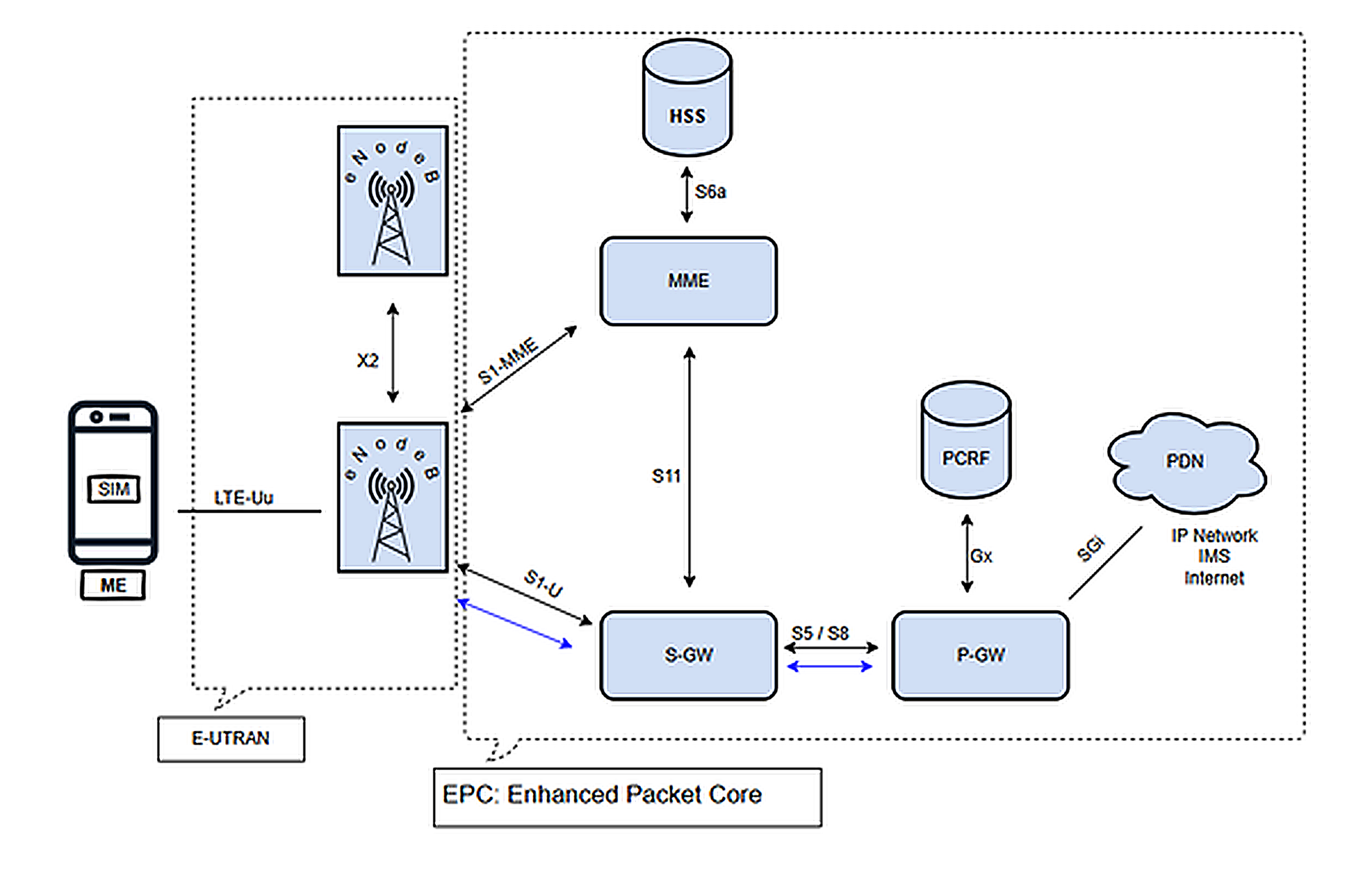
Unlike 3G's Node B, the eNB is an intelligent node — it handles RRC (Radio Resource Control), scheduling, and handover decisions without a centralising RNC above it. eNBs communicate with each other directly via the X2 interface for handovers and interference coordination, and connect to the EPC via the S1 interface.
LTE divides the available spectrum into 15 kHz-spaced subcarriers grouped into Resource Blocks (RBs) of 180 kHz × 1 ms. The scheduler assigns RBs to users dynamically in every Transmission Time Interval (1 ms). The uplink uses SC-FDMA (Single Carrier FDMA) — a variant that reduces the power-hungry peak-to-average power ratio on the handset.
Key radio parameters that drive LTE throughput:
- 2×2 MIMO minimum — two transmit and two receive antennas in both eNB and UE; 4×4 and 8×8 MIMO in LTE-Advanced
- 64-QAM peak modulation — up to 6 bits per symbol; adaptive modulation steps down to QPSK in poor channel conditions
- Channel bandwidths: 1.4, 3, 5, 10, 15, 20 MHz — operators choose bandwidth based on available spectrum; 20 MHz gives the highest single-carrier throughput (~150 Mbps with 2×2 MIMO and 64-QAM)
Evolved Packet Core (EPC) Architecture
The EPC replaced the 3G CN with a leaner, fully IP-based core optimised for high-throughput packet data:
The MME (Mobility Management Entity) is the control-plane anchor: it handles UE attach/detach, authentication (EPS-AKA), tracking area management, and paging. It selects the SGW and PGW for each UE session. The HSS (Home Subscriber Server) is the LTE equivalent of the HLR — it stores subscriber profiles, authentication vectors, and service authorisation data.
The S-GW (Serving Gateway) is the local user-plane anchor — it routes packets between the eNB and the P-GW, handles handovers between eNBs, and buffers downlink data when the UE is in idle mode. The P-GW (PDN Gateway) is the internet gateway: it assigns IP addresses, enforces QoS and policy (via PCRF), and routes traffic to/from external packet networks (PDNs). Each UE typically has one P-GW connection for the life of its data session.
Abbreviations
| Abbreviation | Full Form | Abbreviation | Full Form |
|---|---|---|---|
| UE | User Equipment | E-UTRAN | Evolved UMTS Terrestrial Radio Access Network |
| ME | Mobile Equipment | EPC | Evolved Packet Core |
| SIM | Subscriber Identity Module | LTE-Uu | LTE Air Interface (UE ↔ eNodeB) |
| eNodeB / eNB | Evolved Node B (LTE Base Station) | X2 | Interface (eNodeB ↔ eNodeB) |
| MME | Mobility Management Entity | S1-MME | Control Plane (eNB ↔ MME) |
| S-GW | Serving Gateway | S1-U | User Plane (eNB ↔ S-GW) |
| P-GW | PDN Gateway | S11 | Interface (MME ↔ S-GW) |
| HSS | Home Subscriber Server | S5/S8 | Interface (S-GW ↔ P-GW) |
| PCRF | Policy and Charging Rules Function | S6a | Interface (MME ↔ HSS) |
| PDN | Packet Data Network | Gx | Interface (P-GW ↔ PCRF) |
| IMS | IP Multimedia Subsystem | SGi | Interface (P-GW ↔ PDN/Internet) |
| LTE | Long-Term Evolution | VoLTE | Voice over LTE |
Voice over LTE — VoLTE and IMS
Since LTE has no circuit-switched domain, voice calls are carried as IP packets over the IMS (IP Multimedia Subsystem):
- SIP signaling — session setup and teardown use SIP (Session Initiation Protocol) between the UE's IMS client and the IMS core (P-CSCF, I-CSCF, S-CSCF)
- RTP media — the voice payload travels as RTP (Real-time Transport Protocol) streams, using the AMR-WB (Wideband AMR) codec at up to 23.85 kbps — significantly better quality than 2G/3G voice
- Dedicated bearer — the P-GW establishes a GBR (Guaranteed Bit Rate) bearer with QCI 1 (highest priority) for VoLTE, ensuring the voice packets are never delayed by data traffic
- HD Voice — AMR-WB doubles the audio bandwidth to 50–7000 Hz (vs. 300–3400 Hz on narrowband), making VoLTE calls sound noticeably richer and clearer than 3G calls
LTE-Advanced — Rel-10 and Beyond
Combines up to 5 LTE carriers (each up to 20 MHz) into a single logical channel. A UE with 5×20 MHz CA has 100 MHz total bandwidth, enabling theoretical downlink speeds of ~1 Gbps. Carriers can be in the same band (intra-band) or different bands (inter-band).
LTE-Advanced extended MIMO to 4 layers in the downlink (4×4 MIMO) and eventually 8 layers. More spatial streams directly multiply peak throughput — 4×4 MIMO with 256-QAM (Rel-12) roughly doubles the spectral efficiency of basic 2×2 MIMO with 64-QAM.
LTE-Advanced formalised the coexistence of macro cells with small cells (picocells, femtocells). eICIC (enhanced Inter-Cell Interference Coordination) manages interference between layers, enabling dense indoor/urban deployments that multiply capacity without adding spectrum.
Release 12 added 256-QAM modulation on the downlink, pushing bits per symbol from 6 (64-QAM) to 8. Combined with 4×4 MIMO and 3-carrier aggregation, this enables theoretical downlink peaks of ~600 Mbps in real operator spectrum holdings.
4G's Lasting Impact
- Enabled the streaming economy — LTE speeds (20–100 Mbps typical) made HD video streaming, cloud gaming, and real-time navigation reliable on mobile
- Killed the mobile top-up model — cheap, fast LTE data made unlimited or large data plans the commercial norm; mobile browsing overtook desktop browsing globally in 2016
- Foundation for 5G NSA — 5G Non-Standalone mode uses the LTE EPC as its core and LTE as the anchor bearer; the vast majority of 5G devices rely on LTE for control-plane signaling
- Security improvements over 3G — NAS-level integrity protection (not just AS-level) was added, closing a class of attacks where network-side signaling could be manipulated
- Still the dominant global standard — as of 2025, LTE remains the most widely deployed mobile technology by geography and subscriber count; it will coexist with 5G for at least a decade